
The short answer
Not always. 925 means the maker says the piece is sterling silver, 92.5% silver. But a stamping punch costs about ten dollars, and anyone can hit it onto brass. So take the stamp as a good sign, then look for a maker's mark next to it, compare the stamp's wear with the rest of the piece, check the spots that rub for a second color, and try a strong magnet.
Free: the hallmark chart
Every common gold, silver, and platinum mark on one printable page, with the letters that cancel the number.
The printable chart is on its way. Leave your email and you’ll get it as soon as it’s done, plus a note when the book is out. You can unsubscribe anytime. Privacy.
A friend once messaged me from a thrift store: “It says 925, not sure what does it mean, not a real silver?”
She was holding real sterling, priced as costume, and she almost put it back.
What 925 means
925 means 925 parts silver out of 1,000. That’s 92.5 percent, the standard for silver jewelry, and the trade calls it sterling. England has regulated it since 1275, so the number has been around for a while.1
Every purity number works the same: move the decimal point one place to the left. 925 is 92.5 percent silver, 750 is 75 percent gold, and 835 is 83.5 percent silver. So an 835 bracelet in an antique-store tray is real silver too. It follows the German standard.2
Watch out for names that sound like silver and have none in them. German Silver, Nickel Silver, and Alpacca are all copper, nickel, and zinc. EPNS on a spoon means electroplated nickel silver, so you’re holding a nice-looking spoon and that’s it.2
If you find Tiffany silver, ignore the 1837 for now. That’s the year the company started. The purity is the 925 next to it.
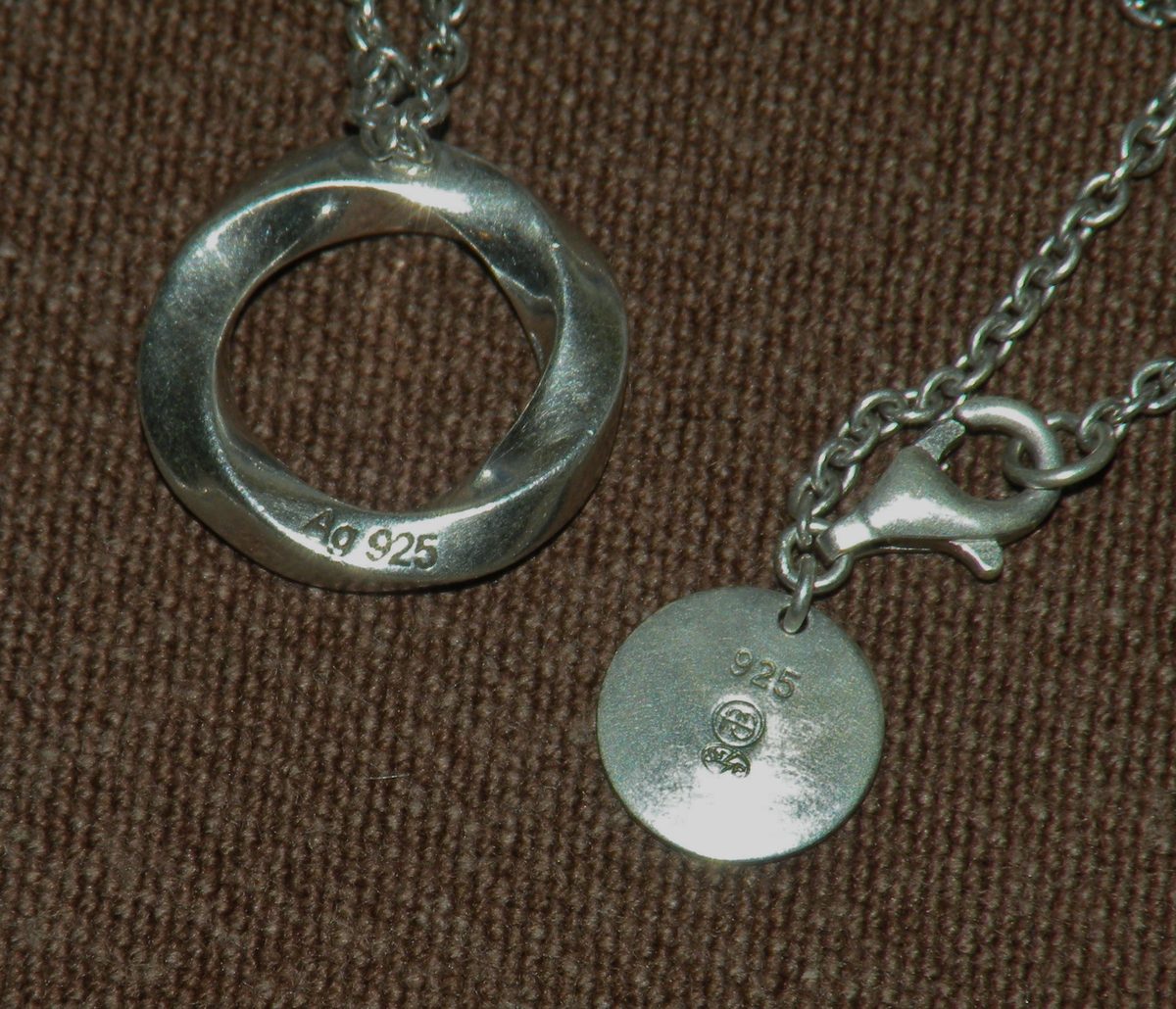
Why one stamp isn’t proof
A stamping punch costs about ten dollars, and anyone can hit any number onto anything they make.3 People who test metal for a living say it plainly: “A hallmark is a claim, not a fact.”4
When a British study looked at 17,657 online “gold” listings, about a quarter were suspected fakes.5 That study was about gold, but a 925 punch is just as easy to buy.
Some fakes give themselves away. A stamp that says “925 Gold” can’t exist, because 925 is a silver number.6
Four checks before you trust a 925
Look next to it. Since 1961, U.S. law has required a maker’s name or trademark next to any gold or silver purity stamp.7 So a lone 925 on a modern piece means keep checking. Old and foreign pieces get a pass here, because plenty of real ones carry the number alone.8
Compare the stamp with the piece. If the chain is worn soft and the 925 looks sharp and fresh, the stamp is younger than the chain. Under a 10x loupe, factory stamps have clean, even edges. Hand-punched fakes look blurry, shallow, or smashed.9
Check the spots that rub. Plating wears off first where metal rubs metal, like the inside of a ring band, the curve of a clasp, or the links of a chain. If you see yellow or copper there, you’re looking at the metal underneath.
Bring a magnet. Silver isn’t magnetic. Use a small, strong neodymium magnet (the one on your fridge is too weak) and touch it to the chain, because clasps are often a different metal.1011 If it snaps on, it isn’t sterling. If it doesn’t, keep checking, because brass isn’t magnetic either.
So, should you buy it?
If it passes all four, pay what you’d shrug off if it turned out to be brass. A few dollars for a marked chain is a fair bet. If the price is a few hundred, get it tested first, because good fakes exist.
Chapters two and five of my book go deeper into stamps, including the four questions that catch a fake 18K. You can read chapter one free, and my hallmark chart has every common stamp on one page.
Sources
-
Silver standards, imposter marks, and the .835 customer anecdote: José Lux, “Silver Purity Standards 2026,” April 2026; plating marks also per US Gold & Coin, “Silver Stamps on Jewelry,” March 2026. ↩
-
Silver standards, imposter marks, and the .835 customer anecdote: José Lux, “Silver Purity Standards 2026,” April 2026; plating marks also per US Gold & Coin, “Silver Stamps on Jewelry,” March 2026. ↩ ↩2
-
Frugal Refiner (moderator), Gold Refining Forum, “Gold Filled/Plated Jewelry” thread, August 2021. ↩
-
“Beyond the Stamp: Why Hallmarks Can’t Guarantee Jewelry Purity,” VRX/XRF technical blog, January 2026 — the “claim, not a fact” phrasing, loupe criteria for genuine vs. hand-punched marks, the missing-trademark red flag, and the tungsten density figures. Note: the vendor sells testing equipment; its own counterfeit-rate estimates are excluded here for that reason. ↩
-
British Hallmarking Council internet-sweep study (WRi Group with INCOPRO, March 21–April 1, 2019), as published by the Goldsmiths’ Company Assay Office, “Consumer Watch: One third of ‘gold’ jewellery sold online could be fake” (2019): 36% of 17,657 listings not advertised as hallmarked; 24% suspected fake; ~150,000 fake items estimated listed annually in the UK. The veteran assayer’s forged-vs-pseudo-marks distinction is from the same office’s “Assistance to Trading Standards” consumer guidance. ↩
-
“How to Spot Fake Jewelry Marks: Complete Detection Guide,” Jewelry Carats, January 2026. Source for the $150 bracelet case study, the five counterfeit categories, and the impossible-marks list. ↩
-
National Gold and Silver Stamping Act of 1906, section 4(b), added by Pub. L. 87-354, October 4, 1961, 75 Stat. 775, effective early 1962 (15 U.S.C. § 297(b)): anyone applying a gold or silver quality mark must apply a registered (or applied-for) trademark or their name, by the same means and as close as possible to the quality mark. Stuller’s summary of the Act notes that no U.S. law requires a quality mark in the first place; the rule bites only when one appears. ↩
-
Comment under “Let’s play ‘Which One of My Parents Is Lying’?,” r/JewelryIdentification, May 20, 2025, reddit.com/comments/1kr8ntr (a ring marked only 10k); “Great-grandmother’s necklace,” r/JewelryIdentification, January 7, 2025, reddit.com/comments/1hviei4 (a Scottish heirloom marked only 9ct). Identifiers’ readings, not tests. ↩
-
“Beyond the Stamp: Why Hallmarks Can’t Guarantee Jewelry Purity,” VRX/XRF technical blog, January 2026 — the “claim, not a fact” phrasing, loupe criteria for genuine vs. hand-punched marks, the missing-trademark red flag, and the tungsten density figures. Note: the vendor sells testing equipment; its own counterfeit-rate estimates are excluded here for that reason. ↩
-
Tool prices per WorthLens, “Inherited Jewelry: How to Find Out What It’s Really Worth,” April 2026 (loupe under $20), and Investopedia (neodymium magnet, “a few bucks”). ↩
-
“There’s No Paperwork, No Appraisals, Nothing…” Investopedia advice desk, December 10, 2025. The letter and the magnet/stamp guidance cited here, including testing the chain rather than the clasp and skipping DIY acid and vinegar tests, appear in the same article. ↩